Retold in our own words from Apollodorus, Library, Epitome 1.7–1.11 (Theoi Project translation), with Ovid, Metamorphoses 8.152–182, Britannica and museum records · Published 30 October 2026
The tribute
History In Greek myth the Minotaur had the body of a man and the head of a bull, and was shut up in the Labyrinth that Daedalus built for King Minos. Britannica: Minotaur ↗
History Britannica says Minos demanded seven Athenian young men and seven young women every ninth year, or, in another version, every year. Britannica: Minotaur ↗
Literature In Apollodorus’ Epitome, Theseus goes to Crete among the young people sent as the third tribute to the Minotaur. Some say he offered to go. Apollodorus, Library, Epitome 1.7–1.11 (trans. J. G. Frazer, 1921) · Theoi Project ↗
Ariadne’s clue
Literature Ariadne, daughter of King Minos, falls in love with him and promises to help if he will take her to Athens as his wife. Apollodorus, Library, Epitome 1.7–1.11 (trans. J. G. Frazer, 1921) · Theoi Project ↗
Literature She asks Daedalus how to get out of the Labyrinth. On his advice she gives Theseus a clue, which is an old word for a ball of thread. Theseus fastens it to the door and unwinds it behind him as he goes in. Apollodorus, Library, Epitome 1.7–1.11 (trans. J. G. Frazer, 1921) · Theoi Project ↗
Literature Apollodorus says Theseus found the Minotaur in the last part of the Labyrinth and killed it with his fists, then followed the thread back out. Apollodorus, Library, Epitome 1.7–1.11 (trans. J. G. Frazer, 1921) · Theoi Project ↗
Naxos and the black sail
Literature He sails away with Ariadne. At the island of Naxos, Dionysus falls in love with her and carries her off. Apollodorus, Library, Epitome 1.7–1.11 (trans. J. G. Frazer, 1921) · Theoi Project ↗
Literature Theseus forgets to raise a white sail in place of the black one. His father Aegeus sees the black sail from the Acropolis, thinks his son is dead, and dies. Apollodorus, Library, Epitome 1.7–1.11 (trans. J. G. Frazer, 1921) · Theoi Project ↗
History Britannica tells the same black-sail ending: Theseus had promised Aegeus a white sail if he came back successful, but forgot. Britannica (Scholars): Theseus ↗
How the versions differ
Literature Ovid also has Ariadne’s thread lead Theseus out of the Labyrinth. He says Theseus left her on the island of Dia, and that Bacchus set her crown among the stars. Ovid, Metamorphoses 8.152–182 (trans. Brookes More) · Theoi Project ↗
History A black-figure amphora of about 540 BC in the British Museum shows Theseus plunging a sword into the Minotaur’s neck. British Museum: black-figured amphora with Theseus and the Minotaur, 1920,0315.2 ↗
Apollodorus says Theseus killed the Minotaur with his fists; the painter of the British Museum amphora shows him using a sword. Britannica gives the tribute as every ninth year or, in another version, every year. Apollodorus says Dionysus carried Ariadne off from Naxos; Ovid says Theseus left her on Dia and Bacchus, the Latin name for Dionysus, set her crown among the stars.
Knossos and the bull
History Knossos, in Crete, was the capital of the legendary King Minos and the main centre of the Minoan civilisation. Britannica: Knossos ↗
History Excavations at Knossos began under Sir Arthur Evans in 1900. They revealed a palace at the centre of a Bronze Age culture that dominated the Aegean between about 1600 and 1400 BCE. Britannica: Knossos ↗
History It also suggests that the legend of the Minotaur could have arisen from exaggerated accounts of bull leaping in ancient Crete. Britannica: Greek mythology ↗
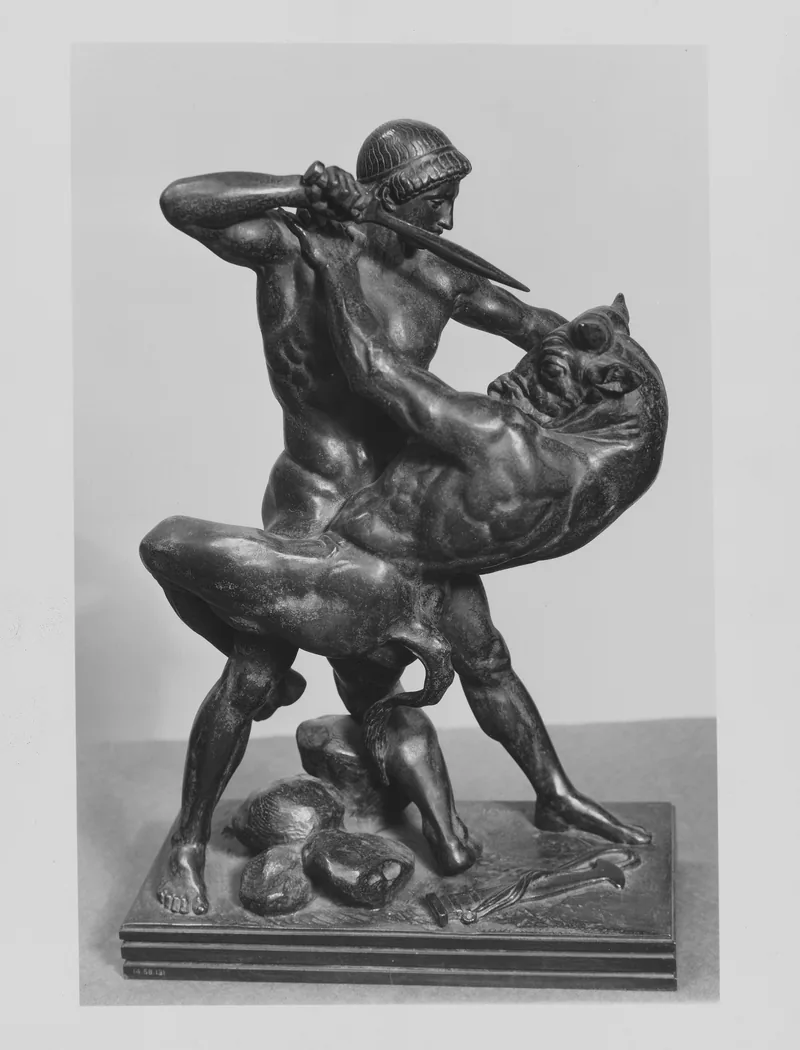
History The French sculptor Antoine-Louis Barye first modelled his bronze Theseus Slaying the Minotaur in 1843. A second version is in The Met. The Met: Barye, Theseus Slaying the Minotaur, 14.58.131 ↗
Follow the thread
Apollodorus, Library, Epitome 1.7–1.11 (trans. J. G. Frazer, 1921) · Theoi Project ↗
Britannica (Scholars): Theseus ↗
Ovid, Metamorphoses 8.152–182 (trans. Brookes More) · Theoi Project ↗
British Museum: black-figured amphora with Theseus and the Minotaur, 1920,0315.2 ↗
The Met: Barye, Theseus Slaying the Minotaur, 14.58.131 ↗
Retellings are in our own words. Every sentence above carries a label (History, Literature or Tradition) and a link to the source it was checked against, with the book and line or section numbers. Where ancient writers tell a myth differently, we name each one.
Source method & more reading ↗