Checked against The Met and British Museum collection records · Published 30 October 2026
Painted pots from Athens
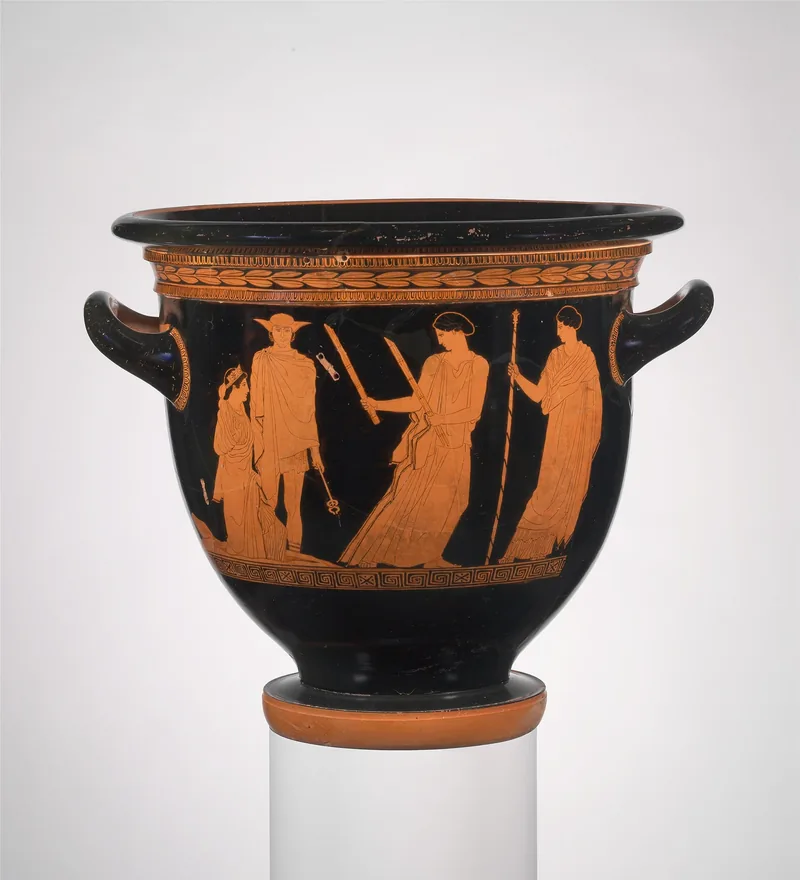
History A Greek bell-krater (a bowl for mixing wine and water) of about 440 BCE in The Met, New York, attributed to the Persephone Painter, shows Persephone rising from the earth, Hermes beside her, Hekate lighting the way with two torches, and Demeter waiting. The Met: bell-krater with the return of Persephone, 28.57.23 ↗
History The museum explains that the Greeks used the story to explain the seasons of the farming year. The Met: bell-krater with the return of Persephone, 28.57.23 ↗
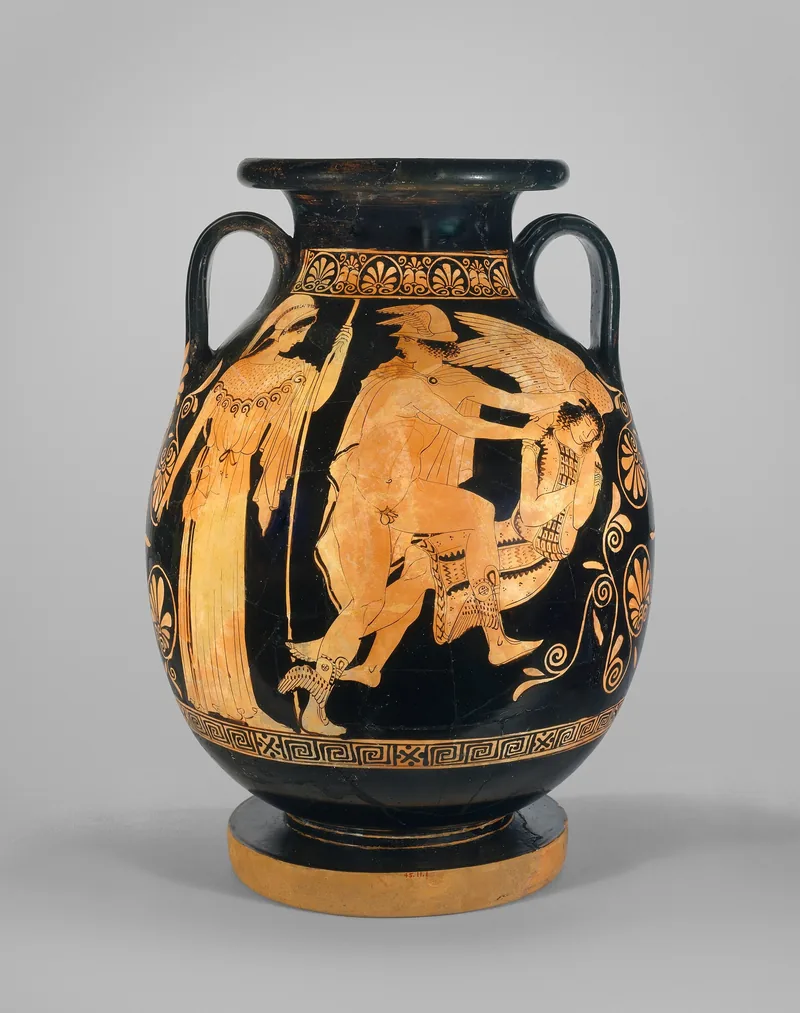
History A jar (pelike) of about 450–440 BCE in The Met, attributed to Polygnotos, shows Medusa asleep, as a beautiful woman, while Perseus looks away towards Athena. The museum notes that in earlier versions Medusa looked ferocious, with snakes instead of hair. The Met: pelike with Perseus and Medusa, attributed to Polygnotos, 45.11.1 ↗
History A black-figure jug (olpe) of about 550–530 BC, made in Attica and now in the British Museum, shows Perseus with the kibisis on his back, killing Medusa with a sword. It is inscribed ‘Amasis made it’. British Museum: olpe with Perseus and Medusa, 1849,0620.5 ↗
History A red-figure water jar (hydria) in the British Museum shows Perseus fleeing after cutting off Medusa’s head. He wears the winged hat and winged boots, with the wallet at his side. British Museum: red-figured hydria with Perseus, 1873,0820.352 ↗
History A black-figure amphora of about 540 BC in the British Museum shows Theseus plunging a sword into the Minotaur’s neck. British Museum: black-figured amphora with Theseus and the Minotaur, 1920,0315.2 ↗
History The British Museum’s ‘Siren Vase’, a red-figure stamnos made in Attica about 480–470 BC, shows another Odyssey adventure: the ship of Odysseus passing the Sirens. British Museum: the Siren Vase (stamnos), 1843,1103.31 ↗
Later artists
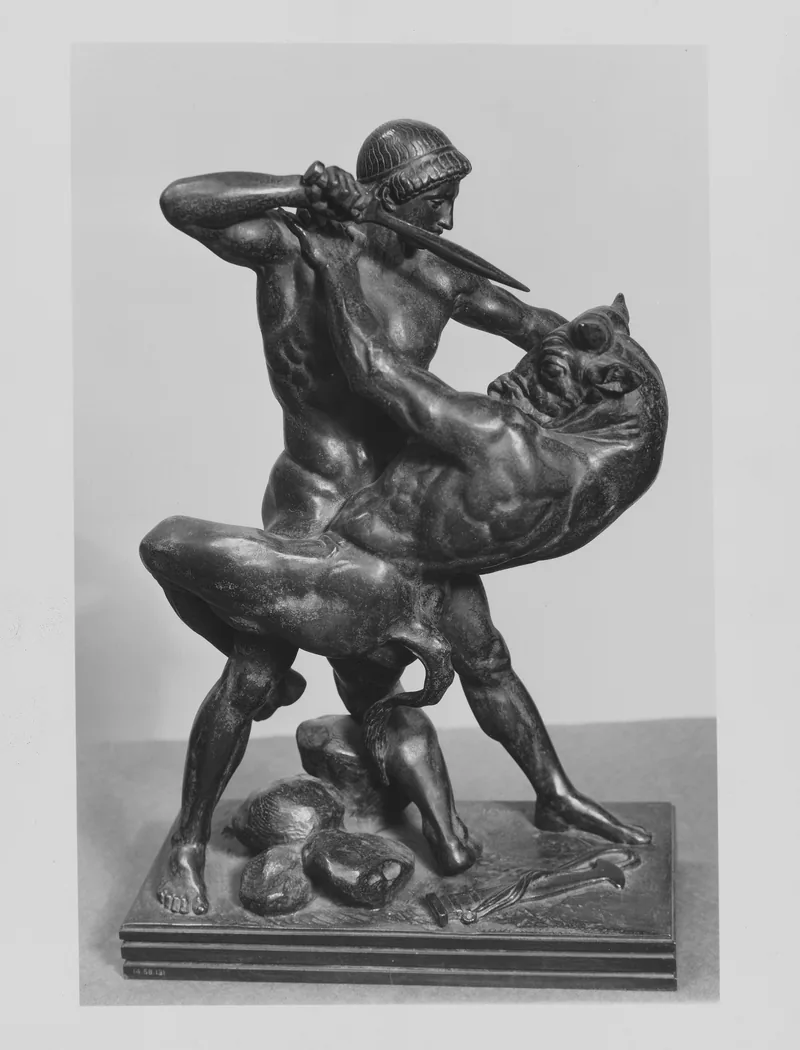
History The French sculptor Antoine-Louis Barye first modelled his bronze Theseus Slaying the Minotaur in 1843. A second version is in The Met. The Met: Barye, Theseus Slaying the Minotaur, 14.58.131 ↗
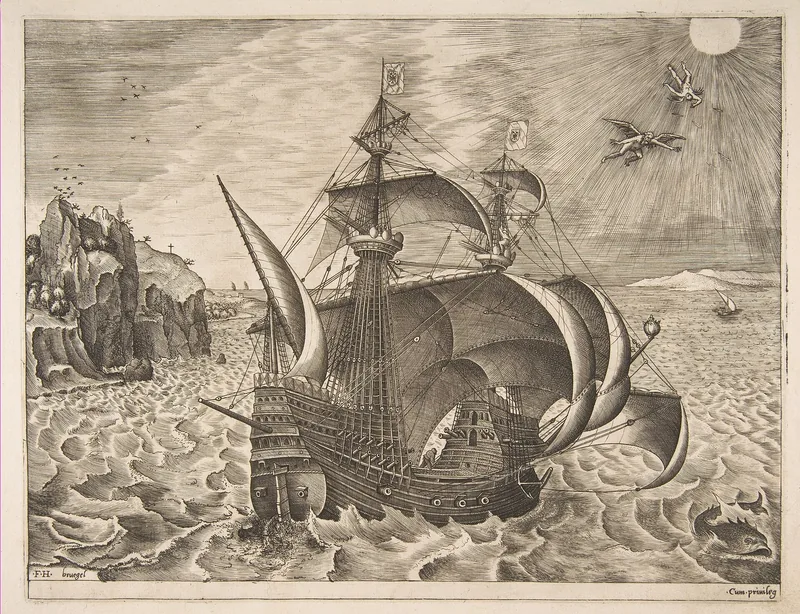
History An engraving of 1561–65 by Frans Huys after Pieter Bruegel the Elder, now in The Met, shows a great sailing ship with Daedalus and Icarus small in the sky above. The Met: Huys after Bruegel, ship with Daedalus and Icarus in the sky, 28.4(2) ↗
How we describe objects
Every object here is described from its museum’s own online record, linked beside each sentence. Dates are the museums’ own estimates. We show pictures only where the museum has released the image as public domain (CC0).
Follow the thread
The Met: bell-krater with the return of Persephone, 28.57.23 ↗
The Met: pelike with Perseus and Medusa, attributed to Polygnotos, 45.11.1 ↗
British Museum: olpe with Perseus and Medusa, 1849,0620.5 ↗
British Museum: red-figured hydria with Perseus, 1873,0820.352 ↗
British Museum: black-figured amphora with Theseus and the Minotaur, 1920,0315.2 ↗
British Museum: the Siren Vase (stamnos), 1843,1103.31 ↗
The Met: Barye, Theseus Slaying the Minotaur, 14.58.131 ↗
The Met: Huys after Bruegel, ship with Daedalus and Icarus in the sky, 28.4(2) ↗
Retellings are in our own words. Every sentence above carries a label (History, Literature or Tradition) and a link to the source it was checked against, with the book and line or section numbers. Where ancient writers tell a myth differently, we name each one.
Source method & more reading ↗