Retold in our own words from Homer, Odyssey 8.482–520 and 4.265–289, and Apollodorus, Library, Epitome 5.14–5.19 (Theoi Project translations), with Britannica · Published 30 October 2026
The song of Demodocus
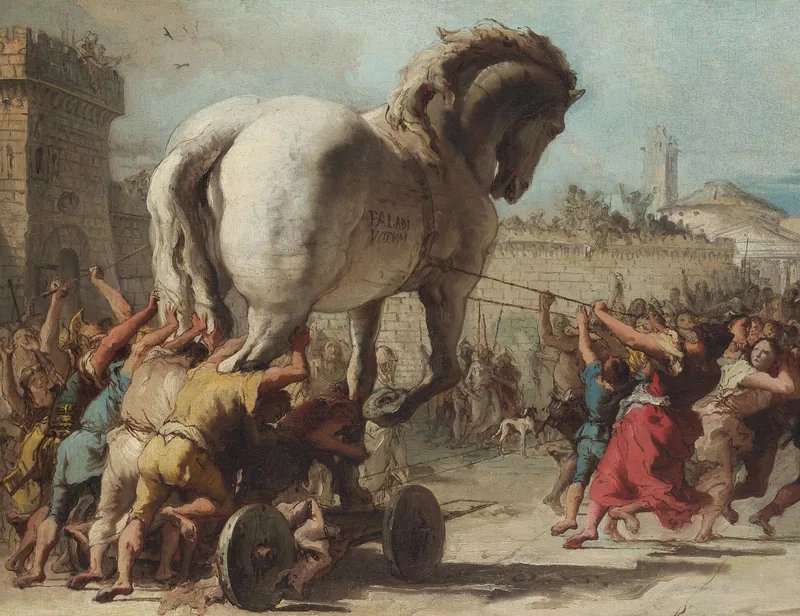
Literature In the Odyssey, Odysseus asks the singer Demodocus to sing of the wooden horse, which Epeius built with Athena’s help and which Odysseus brought into the citadel of Troy, filled with men. Homer, Odyssey 8.482–520 (trans. A. T. Murray) · Theoi Project ↗
Literature Demodocus sings that the Trojans argued: some wanted to cut it open, some to throw it from the rocks, and some to leave it as an offering to the gods. The last plan won. Homer, Odyssey 8.482–520 (trans. A. T. Murray) · Theoi Project ↗
Helen at the horse
Literature In another part of the Odyssey, Menelaus remembers Helen walking round the hollow horse calling the Greek leaders by name, imitating the voices of their wives. Homer, Odyssey 4.265–289 (trans. A. T. Murray) · Theoi Project ↗
Literature Odysseus held the others back. Only Anticlus wanted to answer her, so Odysseus held his mouth shut with his strong hands until Pallas Athena led Helen away. Homer, Odyssey 4.265–289 (trans. A. T. Murray) · Theoi Project ↗
Apollodorus’ version
Literature Apollodorus, who uses Odysseus’ Latin name, Ulysses, says Ulysses thought of the horse and suggested it to Epeus, an architect, who built it from timber cut on Mount Ida. Fifty of the best Greeks hid inside, he says, but the author of the poem called the Little Iliad says three thousand. Apollodorus, Library, Epitome 5.14–5.19 (trans. J. G. Frazer, 1921) · Theoi Project ↗
Literature On the horse, he says, the Greeks wrote that it was a thank-offering to Athena for their return home. Apollodorus, Library, Epitome 5.14–5.19 (trans. J. G. Frazer, 1921) · Theoi Project ↗
Literature In his telling, Cassandra warns that there are armed men inside, and Laocoon agrees, but the Trojans keep the horse. Apollodorus, Library, Epitome 5.14–5.19 (trans. J. G. Frazer, 1921) · Theoi Project ↗
Homer’s translator spells the builder Epeius; Apollodorus’ translator spells him Epeus. They are the same man. Apollodorus gives two numbers for the men inside: fifty, or three thousand in the Little Iliad.
Virgil, and the legend
Literature Book II of Virgil’s Aeneid, a Latin poem, contains the best-known account of the sack of Troy. Britannica: Troy ↗
Literature In the legend as Britannica summarises it, Epeius builds the horse with Athena’s help, warriors hide inside, and the rest of the Greek army sails to the nearby island of Tenedos, pretending to give up the siege. Britannica: Troy ↗
History The wooden horse is often credited to Odysseus’ cunning. Britannica: Odysseus ↗
Was there a Troy?
History Homer’s Iliad and Odyssey are the earliest literary evidence for the legends of the Trojan War; the stories were added to by later Greek and Latin writers. Britannica: Troy ↗
History Britannica says the tales of more than one sack of Troy are supported by archaeological evidence. Britannica: Greek mythology ↗
History Legends such as the Trojan War were generally thought by the Greeks to have really happened. Britannica: Greek mythology ↗
Follow the thread
Homer, Odyssey 8.482–520 (trans. A. T. Murray) · Theoi Project ↗
Homer, Odyssey 4.265–289 (trans. A. T. Murray) · Theoi Project ↗
Apollodorus, Library, Epitome 5.14–5.19 (trans. J. G. Frazer, 1921) · Theoi Project ↗
Retellings are in our own words. Every sentence above carries a label (History, Literature or Tradition) and a link to the source it was checked against, with the book and line or section numbers. Where ancient writers tell a myth differently, we name each one.
Source method & more reading ↗