Retold in our own words from Apollodorus, Library 2.4.1–2.4.3 (Theoi Project translation), with Ovid, Metamorphoses 4.604–803, Britannica and museum records for the other versions · Published 30 October 2026
A chest on the sea
Literature In Apollodorus’ Library, King Acrisius is told by an oracle that his daughter Danae will have a son who will kill him, so he shuts her in a bronze chamber underground. Some say Zeus came to her as a stream of gold, and she had a son, Perseus. Apollodorus, Library 2.4.1–2.4.3 (trans. J. G. Frazer, 1921) · Theoi Project ↗
Literature Acrisius puts Danae and the baby into a chest and casts it into the sea. It washes up on the island of Seriphus, where Dictys brings the boy up. Apollodorus, Library 2.4.1–2.4.3 (trans. J. G. Frazer, 1921) · Theoi Project ↗
Literature Polydectes, king of Seriphus, wants to marry Danae, but Perseus, now grown up, stands in his way. When Perseus boasts that he would not refuse even the Gorgon’s head as a gift, Polydectes orders him to bring it. Apollodorus, Library 2.4.1–2.4.3 (trans. J. G. Frazer, 1921) · Theoi Project ↗
History Britannica gives Danae’s father as Acrisius of Argos, and says Polydectes, who wanted to marry Danae, tricked Perseus into promising to fetch Medusa’s head. Britannica: Perseus ↗
The sisters and the nymphs
Literature Guided by Hermes and Athena, Perseus finds the daughters of Phorcus, three sisters who share one eye and one tooth. He takes them, and gives them back only when the sisters show him the way to the nymphs. Apollodorus, Library 2.4.1–2.4.3 (trans. J. G. Frazer, 1921) · Theoi Project ↗
Literature The nymphs give him winged sandals, a bag called the kibisis, and the cap of Hades that makes him invisible. Hermes gives him a sickle of adamant. Apollodorus, Library 2.4.1–2.4.3 (trans. J. G. Frazer, 1921) · Theoi Project ↗
Medusa
Literature Medusa is the only one of the Gorgons who can die. Because anyone who looks at the Gorgons turns to stone, Perseus looks at her reflection in a bronze shield while Athena guides his hand. Apollodorus, Library 2.4.1–2.4.3 (trans. J. G. Frazer, 1921) · Theoi Project ↗
Literature When he cuts off her head, the winged horse Pegasus and Chrysaor spring from her body. Apollodorus, Library 2.4.1–2.4.3 (trans. J. G. Frazer, 1921) · Theoi Project ↗
Andromeda, and home
Literature On his way home he finds the princess Andromeda left as prey for a sea monster, because her mother Cassiepea boasted she was more beautiful than the Nereids. Perseus kills the monster and frees her. Apollodorus, Library 2.4.1–2.4.3 (trans. J. G. Frazer, 1921) · Theoi Project ↗
Literature Back on Seriphus he turns Polydectes and his friends to stone with the Gorgon’s head, then gives the head to Athena, who puts it in the middle of her shield. Apollodorus, Library 2.4.1–2.4.3 (trans. J. G. Frazer, 1921) · Theoi Project ↗
History Perseus, Cepheus, Cassiopeia, Andromeda and the sea monster (Cetus) all have constellations named after them. Britannica: Perseus ↗
How the versions differ
History Britannica gives two versions of where Perseus got his equipment. In one, the Graiae (the sisters with one eye) give him the sandals, cap, sword and bag. In another, they only point him to the nymphs, who give him the bag, sandals and helmet, and Hermes gives him the sword. Britannica: Perseus ↗
Literature The Perseus Digital Library at Tufts University gives the same Frazer translation of Apollodorus, with the daughters of Phorcus sharing ‘one eye and one tooth’. Perseus Digital Library: Apollodorus, Library 2.4.2 (trans. J. G. Frazer) ↗
Literature In Ovid, Perseus tells of only two sisters, who take turns with a single eye. He took it as one was handing it to the other. Ovid, Metamorphoses 4.604–803 (trans. Brookes More) · Theoi Project ↗
History Homer spoke of a single Gorgon. Hesiod made them three sisters: Stheno, Euryale and Medusa. Britannica (Students): Medusa ↗
Literature Ovid says Medusa was once very beautiful, famous above all for her hair, and that Minerva changed her hair into snakes. Ovid, Metamorphoses 4.604–803 (trans. Brookes More) · Theoi Project ↗
History In early Greek art the Gorgons were usually shown with wings, snakes for hair and grotesque round faces. Later, Medusa was sometimes shown as very beautiful. Britannica (Students): Medusa ↗
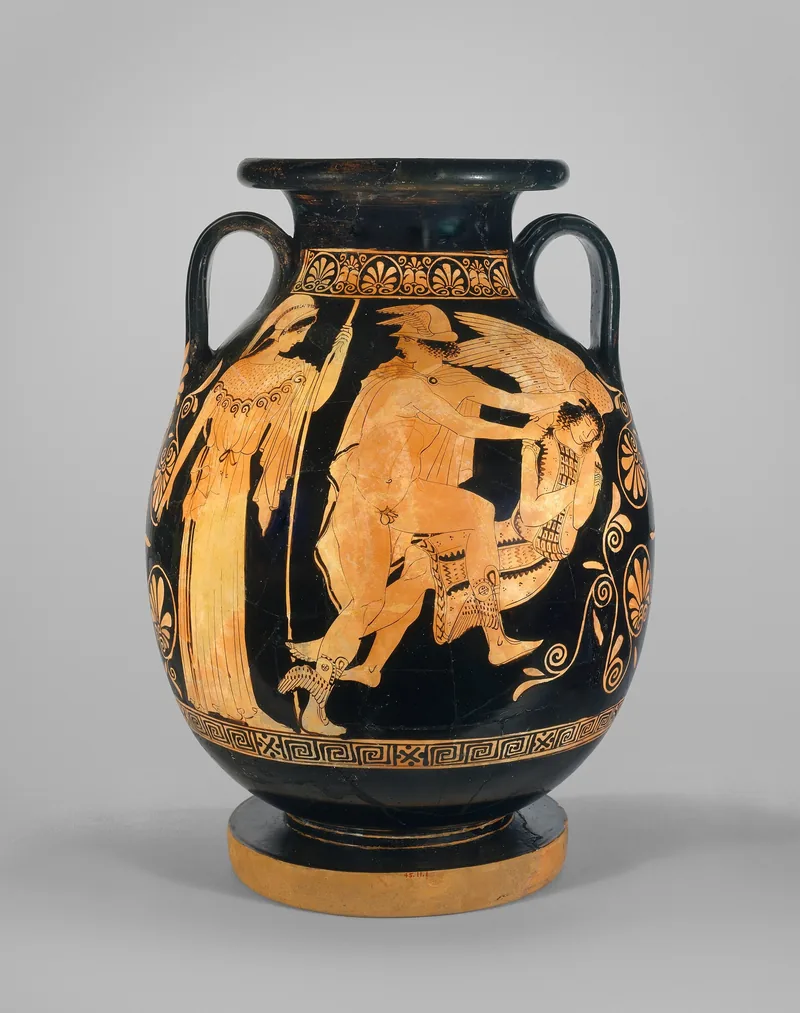
History A jar (pelike) of about 450–440 BCE in The Met, attributed to Polygnotos, shows Medusa asleep, as a beautiful woman, while Perseus looks away towards Athena. The museum notes that in earlier versions Medusa looked ferocious, with snakes instead of hair. The Met: pelike with Perseus and Medusa, attributed to Polygnotos, 45.11.1 ↗
History According to another account, Perseus buried the head in the marketplace of Argos instead of giving it to Athena. Britannica (Students): Medusa ↗
Literature Ovid also tells how Perseus laid the head on seaweed, which hardened at its touch. The sea nymphs tried it with more seaweed, and that, he says, is how coral began. Ovid, Metamorphoses 4.604–803 (trans. Brookes More) · Theoi Project ↗
Apollodorus says three sisters, Ovid two. Apollodorus has the nymphs lend the equipment; one version in Britannica has the Graiae give it. Ovid makes Medusa beautiful before her change, while early Greek artists showed a monster. And the head ends up either on Athena’s shield or buried at Argos, depending on the account.
Perseus in the British Museum
History A black-figure jug (olpe) of about 550–530 BC, made in Attica and now in the British Museum, shows Perseus with the kibisis on his back, killing Medusa with a sword. It is inscribed ‘Amasis made it’. British Museum: olpe with Perseus and Medusa, 1849,0620.5 ↗
History A red-figure water jar (hydria) in the British Museum shows Perseus fleeing after cutting off Medusa’s head. He wears the winged hat and winged boots, with the wallet at his side. British Museum: red-figured hydria with Perseus, 1873,0820.352 ↗
An Isle of Man question
History An archaeologist, R. J. A. Wilson, writes that the three-legged symbol (triskeles) is first found in Sicily in the 7th century BC, and was later given a Medusa head at its centre. R. J. A. Wilson, ‘On the Trail of the Triskeles’, Cambridge Archaeological Journal 10.1 (2000), abstract ↗
History He suggests the Isle of Man adopted the triskeles in 1266, and explores a possible link with Sicily only tentatively. The Manx legs wear armour and spurs, not wings. R. J. A. Wilson, ‘On the Trail of the Triskeles’, Cambridge Archaeological Journal 10.1 (2000), abstract ↗
History Manx National Heritage says the Three Legs of Mann appear to have been adopted in the 13th century as the arms of the kings of Mann, and that it is not known for sure why. Manx National Heritage: Three Legs of Mann ↗
None of these sources says that the Three Legs of Mann came from the story of Perseus and Medusa. The Medusa head belongs to some Sicilian versions of the three-legged symbol. Wilson explores a link between Sicily and the Isle of Man only tentatively, and Manx National Heritage says nobody knows for sure why the emblem was adopted.
Follow the thread
Apollodorus, Library 2.4.1–2.4.3 (trans. J. G. Frazer, 1921) · Theoi Project ↗
Perseus Digital Library: Apollodorus, Library 2.4.2 (trans. J. G. Frazer) ↗
Ovid, Metamorphoses 4.604–803 (trans. Brookes More) · Theoi Project ↗
Britannica (Students): Medusa ↗
The Met: pelike with Perseus and Medusa, attributed to Polygnotos, 45.11.1 ↗
British Museum: olpe with Perseus and Medusa, 1849,0620.5 ↗
British Museum: red-figured hydria with Perseus, 1873,0820.352 ↗
Manx National Heritage: Three Legs of Mann ↗
Retellings are in our own words. Every sentence above carries a label (History, Literature or Tradition) and a link to the source it was checked against, with the book and line or section numbers. Where ancient writers tell a myth differently, we name each one.
Source method & more reading ↗