Retold in our own words from the Homeric Hymn to Demeter 1–495, with Apollodorus 1.5 and Ovid, Metamorphoses 5.341–571 for the other versions (Theoi Project translations) · Published 30 October 2026
The narcissus
Literature In the Homeric Hymn to Demeter, Persephone is gathering flowers in a soft meadow: roses, crocuses, violets, irises, hyacinths and a wonderful narcissus. Homeric Hymn to Demeter 1–495 (trans. H. G. Evelyn-White, 1914) · Theoi Project ↗
Literature As she reaches for the narcissus, the earth opens on the plain of Nysa and the lord of the dead carries her away in his golden chariot. Homeric Hymn to Demeter 1–495 (trans. H. G. Evelyn-White, 1914) · Theoi Project ↗
Demeter’s search
Literature Her mother Demeter searches for nine days, holding flaming torches. Homeric Hymn to Demeter 1–495 (trans. H. G. Evelyn-White, 1914) · Theoi Project ↗
Literature Hecate goes with her to Helios, the Sun, who has seen everything. He tells her that Zeus gave her daughter to Hades as his wife. Homeric Hymn to Demeter 1–495 (trans. H. G. Evelyn-White, 1914) · Theoi Project ↗
Literature Demeter disguises herself as an old woman and comes to Eleusis, where she is taken into the house of Celeus. Homeric Hymn to Demeter 1–495 (trans. H. G. Evelyn-White, 1914) · Theoi Project ↗
History Britannica says that on her journey Demeter revealed her secret rites to the people of Eleusis, who had welcomed her. Britannica: Demeter ↗
The year without a harvest
Literature In her grief she stops the seed from sprouting, and nothing grows on the earth. Zeus at last sends Hermes to bring Persephone back. Homeric Hymn to Demeter 1–495 (trans. H. G. Evelyn-White, 1914) · Theoi Project ↗
Literature Before she goes, Hades secretly gives her a pomegranate seed to eat. Homeric Hymn to Demeter 1–495 (trans. H. G. Evelyn-White, 1914) · Theoi Project ↗
Literature Because she has eaten it, she must spend a third part of each year below, and the rest with her mother. Homeric Hymn to Demeter 1–495 (trans. H. G. Evelyn-White, 1914) · Theoi Project ↗
How the versions differ
Literature Apollodorus says Pluto gave Persephone a single pomegranate seed to eat, and that Ascalaphus bore witness against her. She had to stay a third of every year with Pluto. Apollodorus, Library 1.5.1–1.5.3 (trans. J. G. Frazer, 1921) · Theoi Project ↗
Literature Ovid sets the story in Sicily: Proserpina is picking flowers by Lake Pergus, near Henna, when Pluto takes her. Ovid, Metamorphoses 5.341–571 (trans. Brookes More) · Theoi Project ↗
Literature In Ovid, she picks a pomegranate herself and eats seven of its seeds. Ascalaphus saw her and told. Ovid, Metamorphoses 5.341–571 (trans. Brookes More) · Theoi Project ↗
Literature Ovid’s Jupiter divides the year equally: six months with her mother and six months with her husband. Ovid, Metamorphoses 5.341–571 (trans. Brookes More) · Theoi Project ↗
History Persephone’s Latin name is Proserpina or Proserpine. Britannica (Scholars): Persephone ↗
So the Hymn and Apollodorus say a third of the year, and Ovid says half. In the Hymn, Hades secretly gives her the seed; in Ovid, she picks the fruit herself. The Hymn puts the meadow on the plain of Nysa; Ovid puts it by Lake Pergus, near Henna in Sicily.
The seasons, and a museum bowl
History Britannica says the story that Persephone spent four months of each year below was no doubt meant to explain the bare look of Greek fields in full summer, after the harvest and before the autumn rains. Britannica (Scholars): Persephone ↗
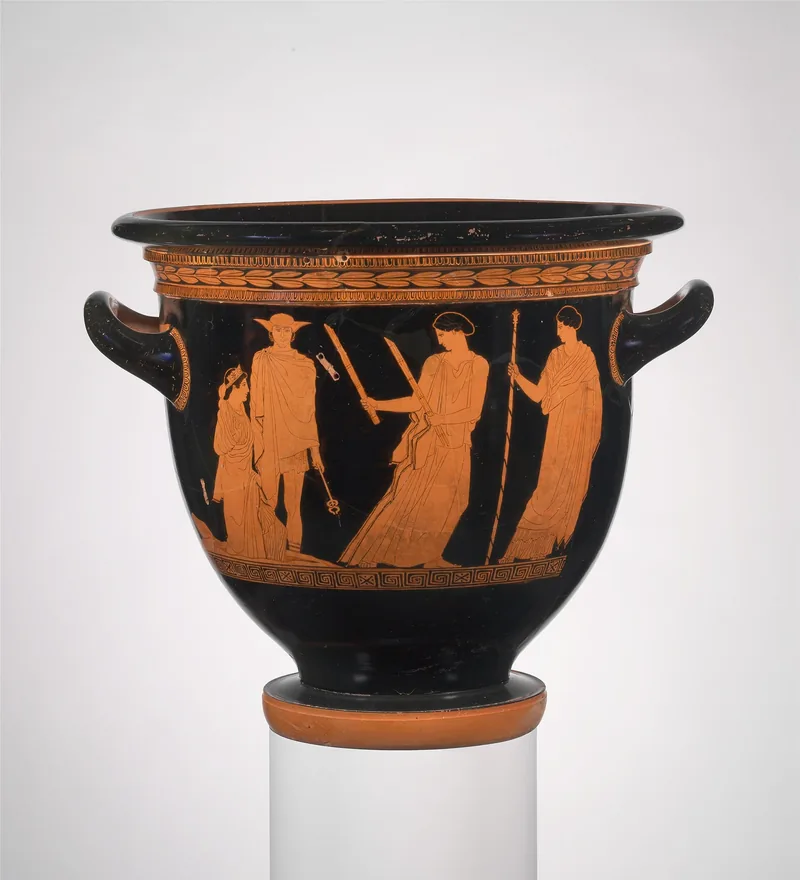
History A Greek bell-krater (a bowl for mixing wine and water) of about 440 BCE in The Met, New York, attributed to the Persephone Painter, shows Persephone rising from the earth, Hermes beside her, Hekate lighting the way with two torches, and Demeter waiting. The Met: bell-krater with the return of Persephone, 28.57.23 ↗
History The museum explains that the Greeks used the story to explain the seasons of the farming year. The Met: bell-krater with the return of Persephone, 28.57.23 ↗
Four months is a third of a year, so the Britannica summary matches the Hymn and Apollodorus rather than Ovid.
History The Homeric Hymns are 34 ancient Greek poems addressed to gods. They were said in ancient times to be by Homer, but they differ widely in date and their authors are unknown. Britannica: Homeric Hymns ↗
Follow the thread
Homeric Hymn to Demeter 1–495 (trans. H. G. Evelyn-White, 1914) · Theoi Project ↗
Apollodorus, Library 1.5.1–1.5.3 (trans. J. G. Frazer, 1921) · Theoi Project ↗
Ovid, Metamorphoses 5.341–571 (trans. Brookes More) · Theoi Project ↗
Britannica (Scholars): Persephone ↗
The Met: bell-krater with the return of Persephone, 28.57.23 ↗
Retellings are in our own words. Every sentence above carries a label (History, Literature or Tradition) and a link to the source it was checked against, with the book and line or section numbers. Where ancient writers tell a myth differently, we name each one.
Source method & more reading ↗