Retold in our own words from Hesiod, Works and Days 42–105 (Theoi Project translation), with Britannica and Hawthorne for the later versions · Published 30 October 2026
Made by the gods
Literature In Hesiod’s Works and Days, Zeus is angry that Prometheus stole fire, and plans a trouble for people in return. Hesiod, Works and Days 42–105 (trans. H. G. Evelyn-White, 1914) · Theoi Project ↗
Literature He tells Hephaestus to mix earth with water and to shape a lovely maiden. Hesiod, Works and Days 42–105 (trans. H. G. Evelyn-White, 1914) · Theoi Project ↗
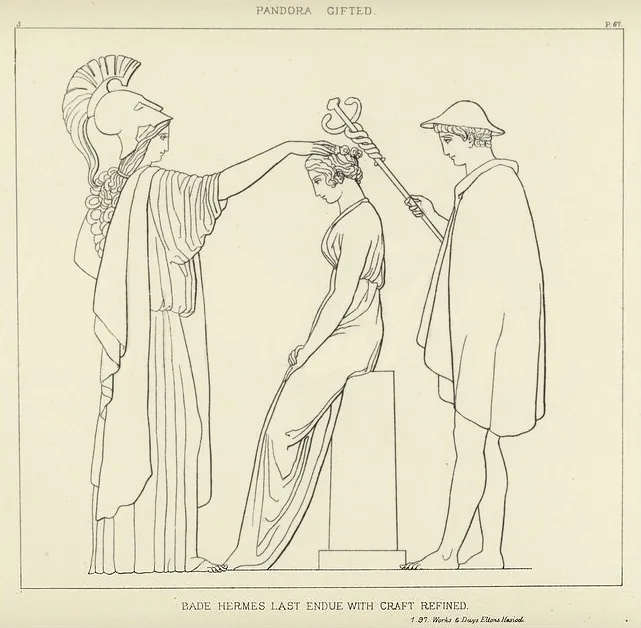
Literature The gods each give her something. Athene teaches her needlework and weaving, the Graces and Persuasion put golden necklaces on her, the Hours crown her with spring flowers, and Hermes gives her a crafty and deceitful heart. Hesiod, Works and Days 42–105 (trans. H. G. Evelyn-White, 1914) · Theoi Project ↗
Literature She is named Pandora, which Hesiod’s translator explains as ‘All Endowed’, because all the gods of Olympus gave her a gift. Hesiod, Works and Days 42–105 (trans. H. G. Evelyn-White, 1914) · Theoi Project ↗
The jar
Literature Prometheus had told his brother Epimetheus never to take a gift from Zeus. But Epimetheus forgot, took the gift, and only understood his mistake afterwards. Hesiod, Works and Days 42–105 (trans. H. G. Evelyn-White, 1914) · Theoi Project ↗
Literature Pandora took the great lid off the jar, and the troubles inside scattered among people. Hesiod, Works and Days 42–105 (trans. H. G. Evelyn-White, 1914) · Theoi Project ↗
Literature Only Hope stayed inside, under the rim of the jar, because the lid went back on before she could fly out. Hesiod, Works and Days 42–105 (trans. H. G. Evelyn-White, 1914) · Theoi Project ↗
Jar or box?
History The jar became a box in the 16th century, when the scholar Erasmus either mistranslated the Greek word or confused it with the box in the story of Cupid and Psyche. Britannica: Pandora ↗
Literature Nathaniel Hawthorne’s 1851 retelling for children, A Wonder Book, tells it with ‘a great box’. Nathaniel Hawthorne, A Wonder Book for Girls & Boys (1851; Walter Crane edition), Project Gutenberg ↗
History In a later story the jar held not troubles but blessings, which were lost when it was opened out of curiosity. Britannica: Pandora ↗
Two poems by Hesiod
History Britannica explains that in Hesiod’s Theogony, after Prometheus stole fire, Zeus had Hephaestus fashion a woman out of earth, and the gods gave her their choicest gifts. Britannica: Pandora ↗
In the lines of the Theogony we checked (507–616), the woman the gods make is not given a name. The name Pandora comes from Works and Days.
Follow the thread
Hesiod, Works and Days 42–105 (trans. H. G. Evelyn-White, 1914) · Theoi Project ↗
Retellings are in our own words. Every sentence above carries a label (History, Literature or Tradition) and a link to the source it was checked against, with the book and line or section numbers. Where ancient writers tell a myth differently, we name each one.
Source method & more reading ↗