Retold in our own words from Homer, Odyssey 9.105–566 (A. T. Murray’s translation on the Theoi Project), checked against the Perseus Digital Library · Published 30 October 2026
The land of the Cyclopes
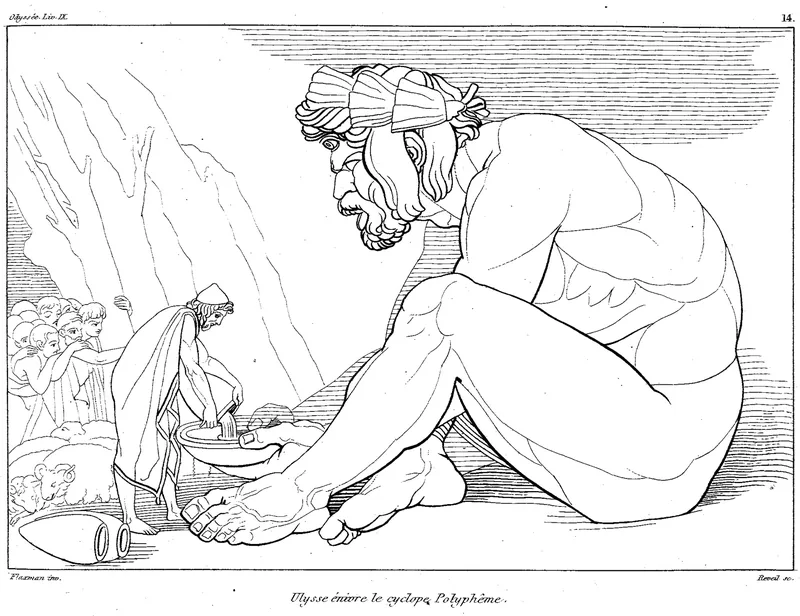
Literature In Homer’s Odyssey, Odysseus tells how his ships came to the land of the Cyclopes, a lawless people who plant nothing and plough nothing. Homer, Odyssey 9.105–566 (trans. A. T. Murray) · Theoi Project ↗
Literature He takes twelve of his best comrades and a goatskin of dark, sweet wine given to him by Maro, a priest of Apollo. Homer, Odyssey 9.105–566 (trans. A. T. Murray) · Theoi Project ↗
Literature They find a cave full of cheeses and pens of lambs and kids. The Cyclops comes home with his flocks and closes the doorway with a huge stone. Homer, Odyssey 9.105–566 (trans. A. T. Murray) · Theoi Project ↗
Guests and a host
Literature Odysseus asks for the gifts owed to guests in the name of Zeus. The Cyclops answers that the Cyclopes do not care for Zeus, and seizes two of the men for his supper. Homer, Odyssey 9.105–566 (trans. A. T. Murray) · Theoi Project ↗
History Britannica points out that Polyphemus rejects xenia, the sacred custom of welcoming guests. Britannica: Cyclops ↗
Literature Odysseus offers him the strong wine. The Cyclops asks his name, and Odysseus says it is ‘Noman’. The Cyclops promises to eat Noman last, as his gift to a guest. Homer, Odyssey 9.105–566 (trans. A. T. Murray) · Theoi Project ↗
Noman
Literature While the Cyclops sleeps, Odysseus and his men heat a sharpened stake of olive wood in the fire and drive it into his one eye. Homer, Odyssey 9.105–566 (trans. A. T. Murray) · Theoi Project ↗
Literature The other Cyclopes come running, but when he shouts that ‘Noman’ is hurting him, they decide nothing is wrong and go away. Homer, Odyssey 9.105–566 (trans. A. T. Murray) · Theoi Project ↗
Literature To escape, Odysseus ties the rams together in threes, with a man under the middle one of each three. He himself clings beneath the best ram of the flock. Homer, Odyssey 9.105–566 (trans. A. T. Murray) · Theoi Project ↗
Literature From his ship Odysseus shouts his real name. The Cyclops, Polyphemus, prays to his father Poseidon to punish him. Homer, Odyssey 9.105–566 (trans. A. T. Murray) · Theoi Project ↗
Three kinds of Cyclopes
History The name Cyclops comes from the Greek words for ‘circle’ and ‘eye’. Britannica: Cyclops ↗
History Hesiod’s Cyclopes are quite different from Homer’s: three divine smiths, Brontes, Steropes and Arges, who forged weapons for the gods. Britannica: Cyclops ↗
History In Homer they are shepherds, and Polyphemus, a son of Poseidon, is the most famous of them. Britannica: Cyclops ↗
History A third tradition said Cyclopes built the huge stone walls of cities such as Tiryns and Mycenae. Britannica: Cyclops ↗
So a Cyclops in Hesiod is a divine smith, a Cyclops in Homer is a shepherd who eats his guests, and a third tradition made Cyclopes into builders. They share a name, not a story.
Checking the text
Literature The Perseus Digital Library prints the same Murray translation of Odyssey 9.105 onwards, where the Cyclopes are ‘an overweening and lawless folk’. Perseus Digital Library: Homer, Odyssey 9.105ff. (trans. A. T. Murray) ↗
History In the Odyssey, Odysseus is away from his kingdom of Ithaca for 20 years: 10 at the Trojan War and 10 on the journey home. Britannica: Odysseus ↗
History The British Museum’s ‘Siren Vase’, a red-figure stamnos made in Attica about 480–470 BC, shows another Odyssey adventure: the ship of Odysseus passing the Sirens. British Museum: the Siren Vase (stamnos), 1843,1103.31 ↗
Follow the thread
Homer, Odyssey 9.105–566 (trans. A. T. Murray) · Theoi Project ↗
Perseus Digital Library: Homer, Odyssey 9.105ff. (trans. A. T. Murray) ↗
British Museum: the Siren Vase (stamnos), 1843,1103.31 ↗
Retellings are in our own words. Every sentence above carries a label (History, Literature or Tradition) and a link to the source it was checked against, with the book and line or section numbers. Where ancient writers tell a myth differently, we name each one.
Source method & more reading ↗