Retold in our own words from Ovid, Metamorphoses 11.85–193 (Theoi Project translation), with Britannica and Hawthorne for the other versions · Published 30 October 2026
Silenus
Literature In Ovid’s Metamorphoses, Phrygian country people catch old Silenus, the companion of Bacchus, as he staggers about, and bring him to King Midas. Midas recognises his old friend, feasts him for ten days and nights, and takes him back to Bacchus. Ovid, Metamorphoses 11.85–193 (trans. Brookes More) · Theoi Project ↗
Literature Bacchus, glad to have his foster-father back, lets Midas choose any reward. Midas asks that whatever he touches should turn to gold. Ovid, Metamorphoses 11.85–193 (trans. Brookes More) · Theoi Project ↗
Everything turns to gold
Literature At first he is delighted: a twig, a stone and an apple all turn to gold. Then his bread and his food turn hard and golden too, and he cannot eat. Ovid, Metamorphoses 11.85–193 (trans. Brookes More) · Theoi Project ↗
Literature Midas begs to be forgiven. Bacchus tells him to follow the stream that flows by Sardis up to its source and plunge into it. When he does, the golden power leaves his body and tints the stream with gold. Ovid, Metamorphoses 11.85–193 (trans. Brookes More) · Theoi Project ↗
History The river is the Pactolus, near Sardis in modern Turkey. The story was used to explain the gold found in its sands. Britannica (Scholars): Midas ↗
The ears of an ass
Literature Later, Pan and Apollo hold a music contest, judged by the mountain god Tmolus. Tmolus gives the prize to Apollo. Everyone agrees except Midas, who calls the judgement unjust, so Apollo gives him the ears of an ass. Ovid, Metamorphoses 11.85–193 (trans. Brookes More) · Theoi Project ↗
Literature Midas hides the ears under a purple turban. But the servant who cuts his hair sees them. Bursting to tell, he digs a hole, whispers the secret into it and fills it in. Reeds grow there and, stirred by the south wind, repeat his words. Ovid, Metamorphoses 11.85–193 (trans. Brookes More) · Theoi Project ↗
How the versions differ
History Britannica says the first written reference to Midas’ golden touch is in Aristotle’s Politics, in the 4th century BCE, and that the stories were first developed in comic Athenian satyr plays. Britannica (Scholars): Midas ↗
History Midas was said to be a king of Phrygia, in what is now Turkey, and son of Gordius, the founder of the city of Gordium. Britannica (Scholars): Midas ↗
History The endings differ: Britannica notes that in some accounts Midas did not survive his golden touch. Britannica (Scholars): Midas ↗
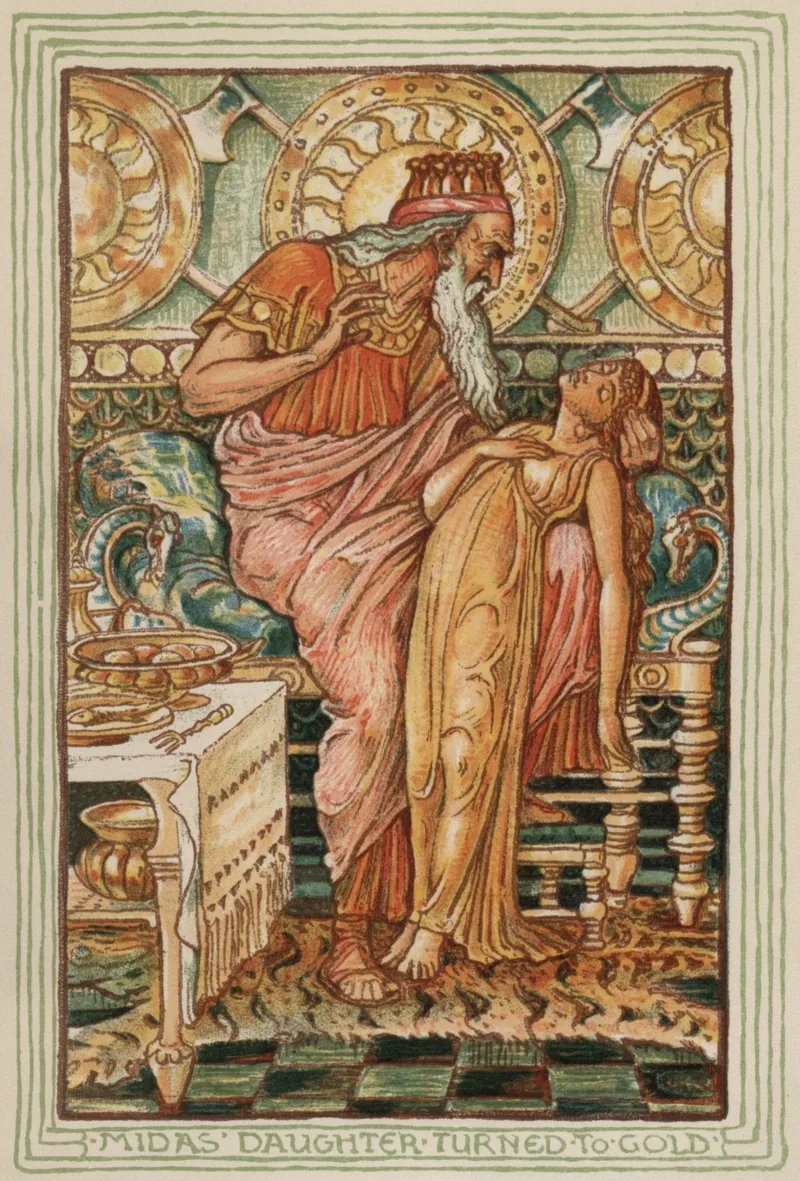
Literature Nathaniel Hawthorne’s 1851 retelling, The Golden Touch, gives Midas a little daughter, ‘whom nobody but myself ever heard of’, and Hawthorne says he chose to call her Marygold. Nathaniel Hawthorne, A Wonder Book for Girls & Boys (1851; Walter Crane edition), Project Gutenberg ↗
Ovid’s Midas has no daughter. The girl turned to gold in many modern retellings comes from Hawthorne’s 1851 version, and Hawthorne himself says nobody else had heard of her. Ovid also calls the god Bacchus, the Roman name for Dionysus.
Follow the thread
Ovid, Metamorphoses 11.85–193 (trans. Brookes More) · Theoi Project ↗
Britannica (Scholars): Midas ↗
Retellings are in our own words. Every sentence above carries a label (History, Literature or Tradition) and a link to the source it was checked against, with the book and line or section numbers. Where ancient writers tell a myth differently, we name each one.
Source method & more reading ↗