Retold in our own words from Ovid, Metamorphoses 8.183–235, with Apollodorus, Library, Epitome 1.12–1.15 (Theoi Project translations) · Published 30 October 2026
Wings of feathers and wax
Literature In Ovid’s Metamorphoses, Daedalus is tired of his long exile on Crete and longs for home, but King Minos controls the sea. Minos may rule the land and the waves, Daedalus thinks, but not the sky. Ovid, Metamorphoses 8.183–235 (trans. Brookes More) · Theoi Project ↗
Literature He lays feathers in rows, from small to large, ties them in the middle with thread and at the bottom with wax, and bends them into the curve of a bird’s wing. Ovid, Metamorphoses 8.183–235 (trans. Brookes More) · Theoi Project ↗
Literature His son Icarus plays beside him, catching floating feathers and pressing the yellow wax with his thumb. Ovid, Metamorphoses 8.183–235 (trans. Brookes More) · Theoi Project ↗
The flight
Literature Daedalus warns him to keep to the middle way: if he flies too low the water may hold him back, and if he flies too high the sun may scorch the wings. Ovid, Metamorphoses 8.183–235 (trans. Brookes More) · Theoi Project ↗
Literature A fisherman, a shepherd and a ploughman look up, see them flying, and think they must be gods. Ovid, Metamorphoses 8.183–235 (trans. Brookes More) · Theoi Project ↗
Literature Proud of his success, Icarus leaves his father and soars higher. The sun’s heat softens and melts the wax, and with no feathers left he falls into the sea calling his father’s name. That sea, Ovid says, is now called the Icarian Sea. Ovid, Metamorphoses 8.183–235 (trans. Brookes More) · Theoi Project ↗
Literature Daedalus buries his son, and the land where he lies is named Icaria. Ovid, Metamorphoses 8.183–235 (trans. Brookes More) · Theoi Project ↗
Apollodorus’ version
Literature Apollodorus gives the warning differently: Daedalus told Icarus not to fly high, in case the glue melted in the sun, and not near the sea, in case the wings came apart in the damp. Apollodorus, Library, Epitome 1.12–1.15 (trans. J. G. Frazer, 1921) · Theoi Project ↗
Literature In Apollodorus, Daedalus flies on to Camicus in Sicily. Apollodorus, Library, Epitome 1.12–1.15 (trans. J. G. Frazer, 1921) · Theoi Project ↗
Literature Minos hunts for him with a spiral shell, offering a reward to anyone who can pass a thread through it. Daedalus ties the thread to an ant, which carries it through the shell. Apollodorus, Library, Epitome 1.12–1.15 (trans. J. G. Frazer, 1921) · Theoi Project ↗
Ovid’s Daedalus warns of the water below and the sun above. Apollodorus has him warn of melting glue and of the damp. Both writers say the sea where Icarus fell was named after him.
Daedalus the craftsman
History The name Daedalus means ‘skilfully wrought’ in Greek. Britannica (Scholars): Daedalus ↗
History Britannica notes that ancient sources give varying accounts of Daedalus’ family, and that his nephew is named Perdix by some writers and Talos by Apollodorus. Britannica (Scholars): Daedalus ↗
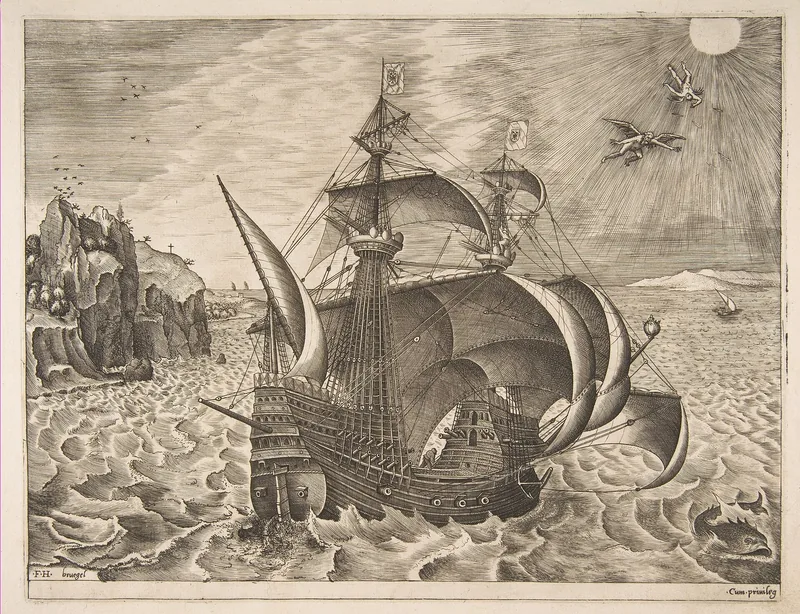
History An engraving of 1561–65 by Frans Huys after Pieter Bruegel the Elder, now in The Met, shows a great sailing ship with Daedalus and Icarus small in the sky above. The Met: Huys after Bruegel, ship with Daedalus and Icarus in the sky, 28.4(2) ↗
Follow the thread
Ovid, Metamorphoses 8.183–235 (trans. Brookes More) · Theoi Project ↗
Apollodorus, Library, Epitome 1.12–1.15 (trans. J. G. Frazer, 1921) · Theoi Project ↗
Britannica (Scholars): Daedalus ↗
The Met: Huys after Bruegel, ship with Daedalus and Icarus in the sky, 28.4(2) ↗
Retellings are in our own words. Every sentence above carries a label (History, Literature or Tradition) and a link to the source it was checked against, with the book and line or section numbers. Where ancient writers tell a myth differently, we name each one.
Source method & more reading ↗